
Syracuse and the surrounding New York area
Concrete Driveway Repair and Replacement in the Syracuse Area
Find out whether a flaking, pitted or cracking driveway needs a patch, a new surface or a full replacement, and what would have to change so the fix lasts.
Driveway Repair quote
A driveway quote is only worth reading if it says which failure it is fixing. Tell us what the surface is doing and which road you back out onto, and we will put you in front of insured contractors who answer that before they price it.
Would you rather talk it through? Call (315) 640-3590, answered 24/7.
$100 off your first job
Credited by us on your first booked job.
- One credit per customer per property, on your first booked job.
- Valid through December 31, 2026.
Mention this offer when you book. Full terms.
Repair the failed sections, or take the slab up
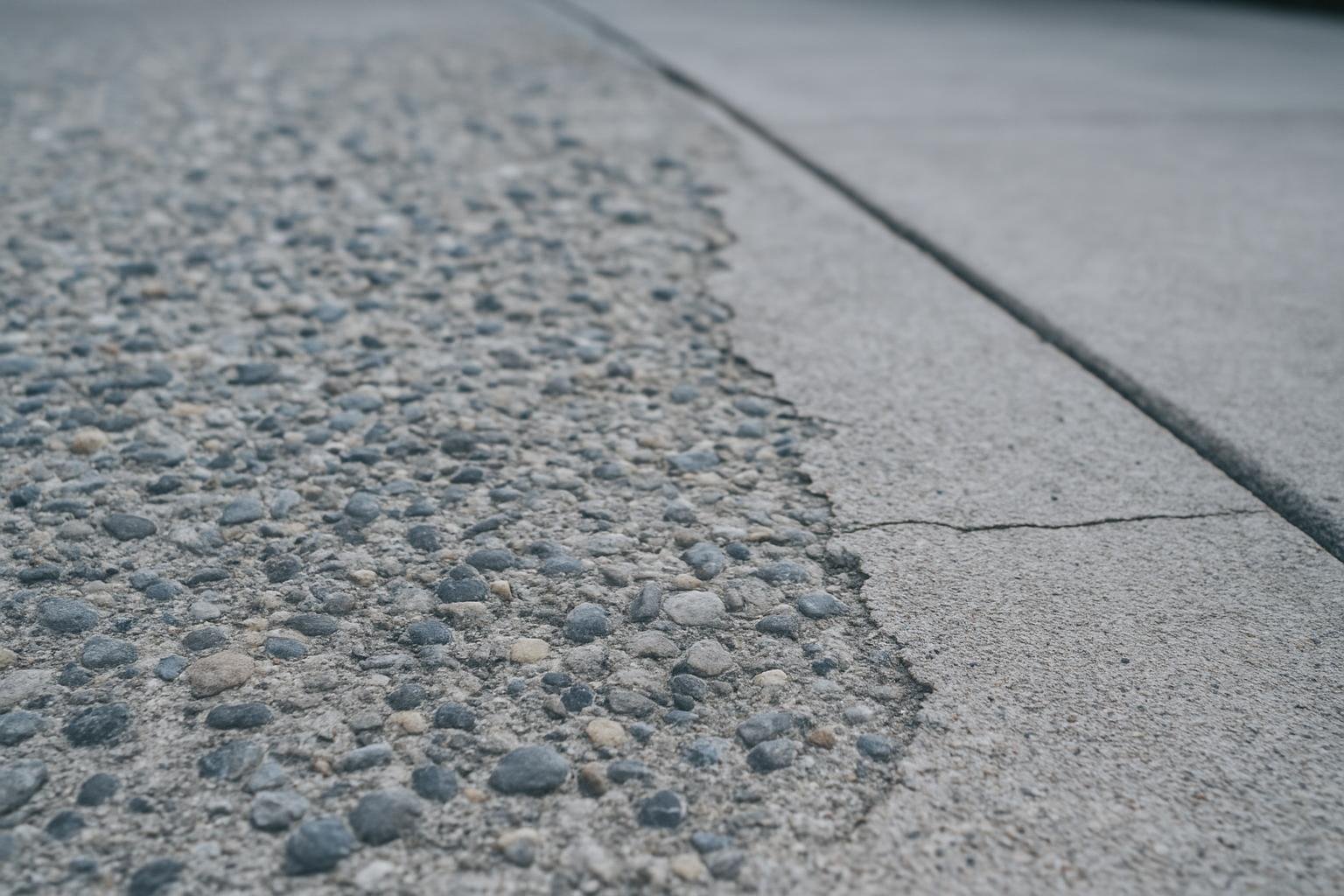
This is the work that either saves a driveway or replaces it. A failed section can be cut out and repoured, a surface that is peeling but sound underneath can sometimes be resurfaced, and a slab breaking up across its whole area is a replacement. The peeling and flaking has a trade name, scaling, and there is a real limit on how far it can be repaired. NRMCA states that light to moderately scaled surfaces can be repaired but the repaired surface will only be as strong as the base surface it has to bond to, and that repairing slabs with excessive and progressing scaling may not be feasible at all. Which side of that line your driveway sits on is most of the decision, and it is knowable before anyone quotes.
- Cutting out and repouring failed sections and panels, with the joints reset where the panels will actually want to crack
- Full removal and replacement, including the fill underneath rather than a fresh slab on the old bedding
- Resurfacing a lightly to moderately scaled driveway where the base surface is still sound enough to bond to
- Crack repair and joint replacement, including the isolation joints where the drive meets the garage slab, the walk and the steps
- Air-entrained concrete specified for the exposure the slab actually gets rather than for a catalog
- Regrading so meltwater and salt solution run off the surface instead of standing on it
- A breathable silane or siloxane repellent on a driveway that is still sound, applied when the concrete is reasonably dry
What moves a driveway price here
A driveway quote moves on what the old slab is sitting on and when the pour can happen, rather than on square footage alone. Six things move it more than size does.
Whether the failure is at the surface or underneath
Peeling and flaking in sheets is scaling, a surface durability failure, and it is repaired from the top. A slab that has sunk or lifted has moved, and no amount of new concrete on top of it will hold. NRMCA's position is that most random cracks, while unsightly, rarely affect the structural integrity or service life of concrete, so the level of the slab matters more than the number of cracks in it. The two jobs cost very different amounts and you cannot separate them by looking only at the top.
How much salt the slab has taken, and where from
You never have to spread a grain for this to happen. NRMCA's written advice is that homeowners should hose off the accumulation of salt deposited by cars on driveways and garage slabs, and it warns that the magnesium-based salts used for pre-snow de-icing of roads get tracked in by cars and accumulate on concrete surfaces. A slab that has been taking that off the road for fifteen winters is being judged on chloride exposure, not on its age.
What air was in the mix, and whether the finishing took it back out
Entrained air is the single property that decides whether flatwork survives freezing and thawing, and ACI 318 sets the target by aggregate size rather than as one number: for the severe freezing classes it runs from 7.5 percent at 3/8 inch stone down to 4.5 percent at 3 inch, and it is 6.0 percent at the 3/4 and 1 inch sizes flatwork actually uses. NRMCA warns separately that excessive finishing reduces the entrained air in the surface layer. That is why two driveways poured off the same truck do not always weather alike.
The month the pour can happen
Cold weather concreting begins, in ACI 306R-16's definition, when air temperature has fallen to or is expected to fall below 40F during the protection period, which is not the same thing as the temperature on the afternoon of the pour. Syracuse averages 13.9 nights a year at or below 40F in October and 24.2 in November. A mild afternoon followed by three cold nights is a cold-weather pour, and it carries protection, heat retention and a longer set that a July pour does not.
What is under the old slab
NRMCA lists improper subgrade preparation among the causes of the majority of concrete cracks. Its basic practice is that topsoil and soft spots come out, the soil beneath is compacted by rolling, vibrating or tamping, and the slab and therefore the subgrade are sloped to drain. Pouring new concrete straight onto the old slab's bedding is the cheapest version of this job and the one most likely to bring you back.
Whether any of the work reaches the road right of way
The strip between your property line and the road shoulder or curb is yours to maintain and, on a county road, not yours to dig up unpermitted. Onondaga County requires a Work in the Right of Way permit for modifications to an existing driveway, widening and repaving included, and 790.4 of the county's 3,144.0 centerline miles are county-owned. So whether the far end of your own driveway needs paperwork depends on the road you back out onto.
Not settled yet on repair or replacement?
That answer comes from the base surface and the ground under it. Worth pinning down before you take a price.
The order a driveway job runs in
Establish which failure you actually have
Scaling is thin flaking and peeling in sheets, and NRMCA grades it: light scaling does not expose the coarse aggregate, moderate scaling exposes it and loses 1/8 to 3/8 inch of surface mortar, and in severe scaling the aggregate stands out. A slab that has sunk or tipped is a different problem entirely. Everything downstream depends on getting this right, and it costs nothing to look properly.
Decide repair, resurface or replace on the base surface
NRMCA is specific about what a resurface needs: the unsound surface must first be removed by hammer and chisel, sandblasting, high-pressure washing or jack hammer, the surface receiving the repair must be sound, and the repaired surface will only be as strong as whatever it has to bond to. It also states that repair material will not match the color and characteristics of the original concrete, which is worth knowing before rather than after.
Confirm which office, if any, has to permit it
The part on your own land is a question for the city, town or village. The strip inside the road right of way belongs to whoever owns the road, and New York Highway Law section 136 makes construction or improvement of an entrance or connection within a county road right of way without a county work permit a violation carrying a fine of not less than twenty-five and not more than one thousand dollars for each day.
Take up the old slab and rebuild what is under it
Topsoil and soft spots out, granular fill compacted, and the subgrade sloped so water leaves. NRMCA adds two winter rules that get skipped: snow and ice come off before concrete is placed, and concrete must not be placed on a frozen subgrade at all.
Specify the mix for the exposure, not for the price
NRMCA's guidance for concrete that will be continuously moist, exposed to freezing temperatures and subject to de-icing chemicals is to order exterior slabs at 4,000 psi, consistent with ACI 332, the code for residential concrete, with a recommended 6 percent total air at 3/4 or 1 inch coarse aggregate, a slump of 3 to 5 inches, and no excessive water added at the jobsite. That last clause is the one that disappears on a hot afternoon.
Set the joints before the pour, not after
NRMCA calls joints pre-planned cracks and says plainly that cracking cannot be prevented entirely, only controlled. Its recommended practice is a maximum joint spacing of 24 to 36 times the slab thickness, about ten feet for a four inch slab, capped at fifteen feet in any case, with panels square or nearly square, length no more than one and a half times the width, and L-shaped panels avoided.
Finish it for the weather rather than for the shine
NRMCA records that concrete sometimes peels or scales with no freezing and thawing involved at all, often from the early use of a steel trowel, over-finishing, or finishing while bleed water is still on the surface. NRMCA's own recommendation for most exterior surfaces is a broom finish. A driveway troweled smooth looks better on the day and weathers worse every year after it.
Protect it, cure it, then keep salt off it
ACI 306R-16 Table 7.2 puts the protection period for normal-set concrete at 2 days with no load and not exposed, 3 days with no load and exposed, and 6 days partially loaded and exposed. Curing is a separate thing and NRMCA puts it at typically 3 to 7 days. Then the first winter: NRMCA's rule is to avoid de-icing chemicals altogether in that winter and to use clean sand for traction instead.
Where this service starts and stops
When you may not need this at all
- A network of fine random cracks across the surface, in irregular patches no more than about an inch and a half across, is crazing. NRMCA states it does not affect the structural integrity of concrete and is generally not a precursor to future deterioration, durability or wear resistance. It often needs nothing at all.
- Light scaling that has not reached the stone is, in NRMCA's own words, a cosmetic issue that may not need to be repaired. If a broom finish is still visible and no aggregate is standing out, watching it for a season is a fair answer.
- Small cone-shaped pits with a piece of fractured stone in the bottom are popouts, caused by an absorptive aggregate particle taking up water and breaking when it freezes. NRMCA records that they typically occur in the first year after placement and that the usual culprit is low density chert in some natural aggregate deposits. A blemish, not a slab failure.
- If the driveway has sunk or tipped rather than broken up, the concrete may be sound and the ground under it may not be. That is settlement work, it is priced completely differently, and it is worth confirming which one you have before taking a quote for the other.
- If the concrete is barely a year old and already peeling, another layer on top is not the first move. NRMCA lists non-air-entrained concrete, too little entrained air especially at the surface, improper finishing, insufficient curing and de-icing chemicals on newly installed concrete among the causes of most scaling. Whoever poured it owes you that conversation first.
What is out of scope
- Asphalt driveways, asphalt patching and sealcoating. This is poured concrete work.
- Pavers, cobble and stone setts, which are set on a bed rather than poured.
- Public sidewalk replacement inside the City of Syracuse. The city took that on itself in the second half of 2021 and funds it with a yearly fee on every property, so there is nothing there for you to buy.
- Work inside a county road right of way without the county permit that governs it. That is arranged as apron and entrance work, with the paperwork first.
- Retaining walls, footings and foundation work, which are structural and carry their own specification.
- Decorative overlays, stamping and staining as standalone cosmetic work.
Where we arrange driveway work
- Driveway Repair in Syracuse
- Driveway Repair in East Syracuse
- Driveway Repair in Solvay
- Driveway Repair in Liverpool
- Driveway Repair in North Syracuse
- Driveway Repair in Salina
- Driveway Repair in Cicero
- Driveway Repair in Clay
- Driveway Repair in DeWitt
- Driveway Repair in Manlius
- Driveway Repair in Fayetteville
- Driveway Repair in Baldwinsville
- Driveway Repair in Skaneateles
- Driveway Repair in Camillus
- Driveway Repair in Marcellus
What people ask before committing to a driveway
Can my driveway be repaired, or does the whole thing have to come up?
There is a published line and it is about the surface, not the age. NRMCA states that light to moderately scaled surfaces can be repaired, that the unsound surface has to be removed first by hammer and chisel, sandblasting, high-pressure washing or jack hammer, that the surface receiving the repair must be sound, and that the repaired surface will only be as strong as the base it has to bond to. It then says that repairing slabs with excessive and progressing scaling may not be feasible at all. So the questions are how deep the damage goes, whether sound concrete is left underneath, and whether the slab is still level. A driveway that is peeling but level and solid is usually a repair. One losing aggregate over most of its area, or one that has moved, usually is not.
Why did the patch I paid for last time fail?
Usually one of four things, and all four are documented rather than mysterious. First, a repair is only ever as strong as the base surface it has to bond to, so new material laid over concrete that was already unsound fails at the bond. Second, NRMCA lists application of excessive de-icing chemicals, especially on newly installed concrete that tends to be saturated and of lower strength, among the causes of most scaling, and new work salted in its first winter is the classic case. Third, excessive finishing reduces the entrained air in the surface layer, so the top skin of a beautifully troweled patch can be the least durable concrete on the property. Fourth, the pour may have happened outside a window it could be protected through. A repair that ignores all four does fail again, which is why the diagnosis is worth more than the discount.
Is it too late in the year to pour a driveway?
It is a protection question rather than a calendar question. ACI 306R-16 defines cold weather concreting as air temperature having fallen to, or being expected to fall below, 40F during the protection period, and sets that period at 2, 3 or 6 days depending on load and exposure. Syracuse averages 13.9 nights at or below 40F in October, 24.2 in November and 30.3 in December, and the median date of the first fall night at or below 32F is October 14. So an October pour will very likely sit through cold nights and has to be protected accordingly. Fresh concrete freezes below about 25F and can lose more than half its potential strength if it does. What is less well known is that NRMCA also notes cold weather concreting offers the opportunity for better quality, because a cooler initial concrete temperature typically results in higher ultimate strength and improved durability. Late season is not automatically wrong. Unprotected late season is.
What should be in the mix for a driveway in this county?
Three respectable sources give three different numbers, and the disagreement is worth knowing rather than hiding. NRMCA, consistent with ACI 332, the code for residential concrete, says order exterior slabs at 4,000 psi with about 6 percent air at 3/4 or 1 inch aggregate and a 3 to 5 inch slump. ACI 318's severest freezing and thawing class, which is the condition of concrete that is frequently wetted, freezes and has de-icing chemicals applied to it, sets a 0.40 maximum water to cementitious ratio and 5,000 psi for reinforced members, and 0.45 and 4,500 psi for plain concrete. The Residential Code of New York State, Table R402.2, asks 3,500 psi with air of not less than 5 and not more than 7 percent by volume in its severe weathering column. A driveway here is wetted, frozen and salted by the cars that use it, which is that severe condition by description, so the upper end of the range is the sensible read rather than the code floor.
Do I need a permit to repave my own driveway?
It depends which road it meets. The part on your own land is a building department question for the city, town or village the house stands in. The strip inside the road right of way is different: Onondaga County requires a Work in the Right of Way permit for all work in the right of way including modifications to existing driveways such as widening and repaving, and New York Highway Law section 136 makes constructing or improving an entrance or connection within a county road right of way without a county work permit a violation carrying a fine of not less than twenty-five and not more than one thousand dollars for each day of violation. Because it accrues for every day the violation continues, it is not a one-off ticket. New York State's highway mileage report puts 790.4 of the county's 3,144.0 centerline miles under county jurisdiction and 1,896.4 under a town, village or city, so it is worth ten minutes to establish which one you are on before ordering anything.
Can I salt a new driveway, and should I seal it?
Not in the first winter. NRMCA's stated rule is to avoid de-icing chemicals in the first winter and to use them in moderate amounts after that, with clean sand for traction in the meantime. It also names calcium chloride and sodium chloride, which is rock salt, as acceptable on concrete, and says ammonium sulfate, ammonium nitrate and magnesium-based salts should never be used as a de-icer because they are chemically aggressive and destroy concrete surfaces. On sealing, NRMCA recommends a commercially available silane or siloxane based breathable concrete sealer or water repellent designed for concrete slabs, applied per the manufacturer's instructions with the concrete reasonably dry, and it names late summer with a few dry days beforehand as the ideal time. Sand and a hose are the two cheapest things you can do for a new slab.
Tell us what the surface is doing
Peeling, pitting, cracking or sunken. That one word changes the whole job.