
Syracuse and the surrounding New York area
Concrete Repair in Syracuse: Driveways, Aprons, Steps and Slabs
Find out what is actually wrong with your concrete, whether it is even yours to fix, and what a repair has to include to survive the next winter. Flatwork here gets wet, freezes and gets salt, which is the severe end of the freezing and thawing exposure scale, and it is the air in the mix rather than the thickness of the slab that decides whether it holds. Tell us what the surface is doing and your town, and we will put you in front of licensed, insured contractors who work in it.
Request a Quote
Share a few details so we can confirm coverage and arrange the right next step.
Would you rather talk it through? Call (315) 640-3590, answered 24/7.
$100 off your first job
Credited by us on your first booked job.
- One credit per customer per property, on your first booked job.
- Valid through December 31, 2026.
Mention this offer when you book. Full terms.
Five different jobs, not five sizes of one
These split by what has actually failed and who is allowed to work on it, not by how much concrete is involved. A surface that is peeling, pitting or flaking has failed at the top, and that stays surface work. A slab that has sunk or tipped has not failed at all: the ground under it moved, which makes it a drainage job before it is a concrete job, and the two need different money spent in different places. The apron at the road is a third thing again, because on a county road the county has to permit the work before anybody pours. The one-line test on each card sorts most people before they type anything.
Driveway Repair and Replacement
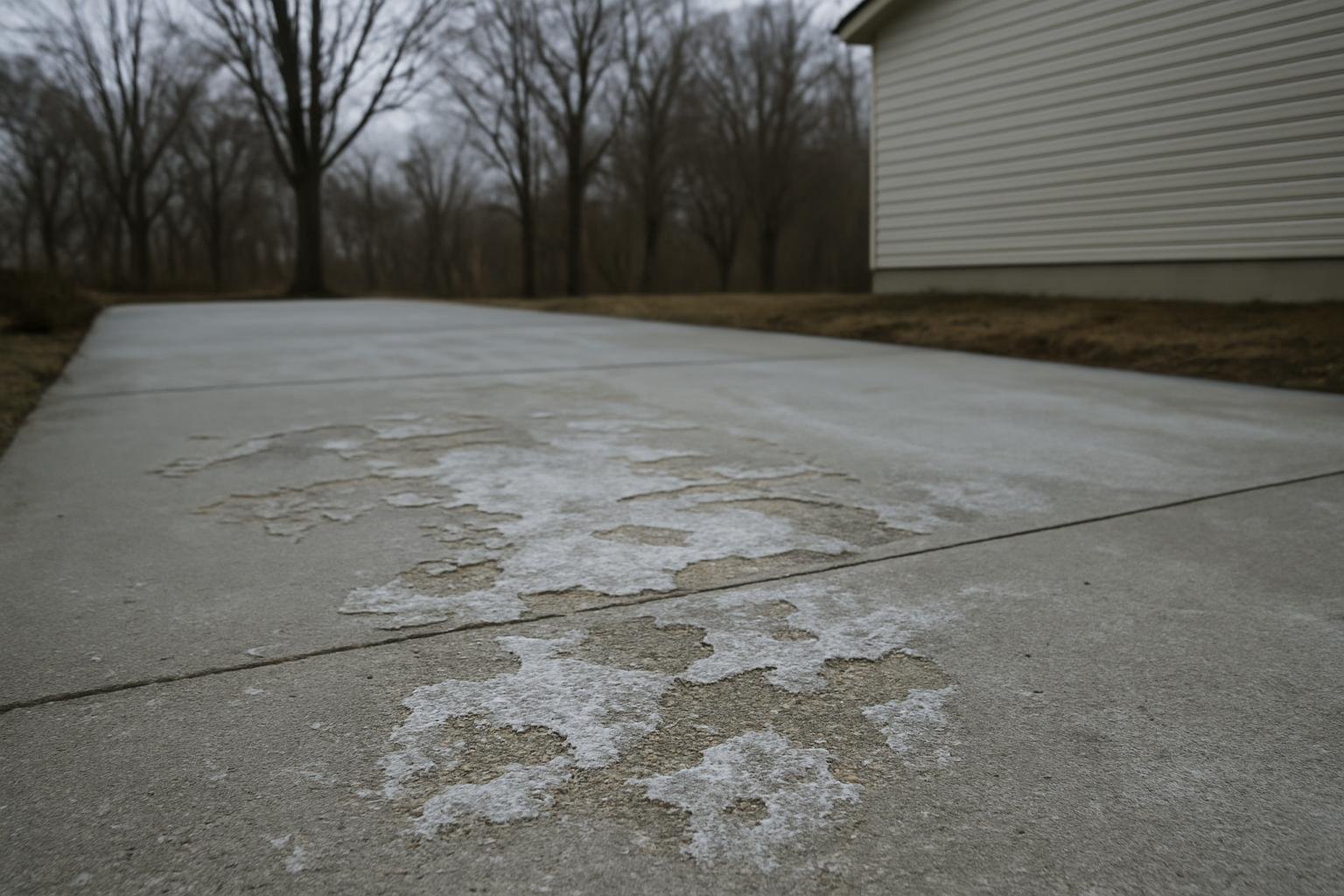
Find out whether a flaking, pitted or cracking driveway needs a patch, a new surface or a full replacement, and what would have to change so the fix lasts.
Start here if the surface is peeling, pitting or cracking across an area rather than in one spot.
About Driveway Repair →Driveway Apron and Entrance
Repair or replace the strip of driveway between your property line and the road, with the permit that governs work in the right of way settled before anyone breaks ground.
Start here if the broken part sits between your property line and the road, or you are widening a drive onto a county highway.
About Apron Repair →Steps, Walkways and Patios
Rebuild crumbling front steps, deal with a stoop that has dropped away from the house, and repair the walkway or patio you have stopped inviting people onto.
Start here if the damage is somewhere you walk rather than somewhere you drive, or a step or stoop has dropped.
About Steps and Walkways →Garage Floors and Slabs
Deal with a garage floor that is pitting, flaking or breaking up where the car parks, and find out whether it needs patching, resurfacing or replacing.
Start here if the floor is pitting or flaking in the wheel tracks or along the line of the door.
About Garage Floor Repair →Concrete Leveling and Settlement Repair
Lift or replace a slab that has sunk, tipped or heaved, and deal with the drainage underneath it so the same thing does not happen next spring.
Start here if a slab has sunk, tipped or lifted, or two slabs that used to meet flush no longer do.
About Concrete Leveling →Not sure which one you need?
Describe what you are seeing and we will tell you what the job actually needs.
How a concrete job starts here
Tell us what the surface is doing, and your town
Those two answers do most of the sorting. Peeling, flaking and pitting are surface failures and stay surface work. A slab that has sunk, tipped or lifted is the ground moving underneath, which is a different job with a different fix. The town matters because work at the end of a driveway is permitted by whoever owns the road it meets, and in this county that is one of three different governments.
Somebody grades the damage before pricing the cure
How deep the loss goes, and whether the stone is standing out of the surface, is how the damage gets graded, and the grade decides the work. Light flaking with no coarse aggregate showing is often cosmetic and can be left alone. Once the stone is exposed the slab has lost measurable thickness, and an overlay laid over failing concrete fails along with it.
A written scope, a mix specification and a date
You get the work, the materials, the price and the payment schedule on paper before anyone breaks ground, which is what New York requires of any home improvement contract above five hundred dollars, with three business days to cancel written into it. Ask for the strength and the air content in writing too, and for a date in a month that suits concrete rather than one that suits the diary.
What makes this a local problem
Air-entrained concrete carries billions of microscopic air cells per cubic foot. Those air pockets relieve internal pressure on the concrete by providing tiny chambers for water to expand into when it freezes. The amount of entrained air is usually between 4 and 7 percent of the volume of the concrete, and it is produced either with air-entraining portland cement or by introducing air-entraining agents.
Source: American Cement Association, formerly the Portland Cement Association, Air-Entrained Concrete, accessed 2026-09-08
NRMCA's written advice is that when conditions permit, homeowners should hose off the accumulation of salt deposited by cars on driveways and garage slabs. It adds that poor drainage causing salt solutions to accumulate on concrete surfaces increases the severity of the exposure and may cause scaling.
Source: National Ready Mixed Concrete Association, Concrete in Practice 2, Scaling Concrete Surfaces, accessed 2026-09-08
Among its rules for preventing scaling, NRMCA advises being cautious about placing exterior concrete in late fall, winter or early spring when conditions are such that it will be exposed to freezing temperatures shortly after placement while the concrete is still saturated.
Source: National Ready Mixed Concrete Association, Concrete in Practice 2, Scaling Concrete Surfaces, accessed 2026-09-08
Under the City of Syracuse's Municipal Sidewalk Maintenance Program the city took responsibility for sidewalks in the second half of 2021. The city's published fact sheet describes the previous policy as one where property owners were responsible for maintenance and replacement of sidewalks, sidewalks were condemned if identified as unsafe with citations primarily complaint-driven, and property owners were required to pay for the construction of new sidewalks. Under the program the city is responsible for the repair and replacement of existing sidewalks and for the annual expansion of the sidewalk network, working with the Syracuse Metropolitan Transportation Council to prioritize pedestrian safety and access. The program establishes four districts on the Department of Public Works quadrant boundaries and spends the funding collected in each district in that district.
Source: City of Syracuse, Municipal Sidewalk Maintenance Program fact sheet, updated October 2023, accessed 2026-09-08
When Syracuse concrete does not need a contractor
Two of the commonest things people call about need nothing done to them, and one of them is not yours to pay for in the first place. Both are worth checking before you take a single quote.
If the cracking is a network of fine random cracks, rarely more than an eighth of an inch deep, in irregular patches no more than an inch and a half across, and it showed up within the first week of the pour, that is crazing. NRMCA states that it does not affect the structural integrity of concrete and is generally not a precursor to future deterioration, durability or wear resistance. Leave it alone. A resurfacing quoted against crazing on a sound slab is work the material does not require.
And if the broken slab is the public sidewalk and the house is inside the City of Syracuse, the city does that work. Under its Municipal Sidewalk Maintenance Program it took responsibility for the repair and replacement of existing sidewalks in the second half of 2021, funded by a yearly fee charged on every property in the city, so a city homeowner who pays a contractor for that slab has paid for it twice. A hazardous sidewalk goes to the city, not to three quotes. What is still yours is the driveway, the apron, the walk from the sidewalk to your own door, the steps, the patio and the garage floor.
We would rather say both of those on the phone than sell a job the concrete does not need. It is also why the first thing we ask is what the surface is doing, not how big the driveway is.
What is different about a concrete job here
We settle whose concrete it is before anyone quotes
Three different governments own the roads in this county. Of 3,144 centerline miles of public highway, 1,896.4 are under a town, village or city, 790.4 are county-owned and 412.6 belong to the state Department of Transportation. Which one governs work at the end of your driveway depends on the single road that driveway meets, and it is public record rather than opinion. Inside the city, the public sidewalk is not yours to pay for at all. Getting that straight is the cheapest part of the job and the part most quotes never mention.
Why it failed is what decides whether a repair holds
NRMCA lists the causes of most scaling, and five of the six are decisions made on the day the slab was poured: too little entrained air, especially at the surface, concrete of low strength that lets water permeate, an improper mixture for the application, poor finishing, and insufficient curing that leaves a weak surface. Only the sixth is what happens afterwards. So a slab that peeled is rarely bad luck and rarely bad weather, and repouring it to the same specification buys the same result in the same number of winters. This is the question we start with, because it is the one that decides whether you are buying a repair or buying it again.
The salt arrives on your car, not from your hand
The trade body names the delivery vehicle itself: NRMCA's written advice is that homeowners should hose off the accumulation of salt deposited by cars on driveways and garage slabs, and it notes that magnesium-based road anti-icers are tracked in by cars and accumulate on concrete. So the garage floor, the most protected-looking concrete on the property, takes the worst of the chloride, and a driveway nobody has ever salted by hand still fails at the salt exposure condition. That changes what the slab should have been specified for, and it changes what protects it afterwards.
The cure for this exact problem was invented in New York
Air entrainment traces to the early 1930s, when the New York State Highway Department went looking for a way to stop the surface scaling that the sodium and calcium chloride spread on icy roads was causing, particularly on new concrete. The blend it introduced worked so well in the field that New York State and most of the New England states adopted it as standard practice. Those billions of microscopic air cells are simply where freezing water goes instead of pushing the top off your slab, and specifying enough of them costs almost nothing on the ticket.
Coverage across Syracuse and the surrounding New York area
What people ask before they call about concrete
How do I know I am not being sold a replacement when a repair would do?
Have the damage graded before you hear a number. NRMCA grades scaling by how much surface has gone: light scaling does not expose the coarse aggregate, moderate scaling exposes it and can involve the loss of an eighth to three eighths of an inch of surface mortar, and in severe scaling more has gone and the stone clearly stands out. Light scaling is a cosmetic issue and may not need repairing at all. Light to moderate can be repaired, though the repair material will not match the color of the original concrete, so anyone promising an invisible patch is promising something the material cannot do. Excessive and progressing scaling is a replacement, because an overlay laid over failing concrete fails along with it. A quote that reaches a price without telling you which of those three you have skipped the only step that mattered.
It has been patched before and it failed. Why would this time be different?
Because of what went into it and when it went in. NRMCA lists the causes of most scaling and five of the six are decisions taken on the day: too little entrained air, especially at the surface, low strength concrete that lets water permeate, an improper mixture for the application, poor finishing, and insufficient curing leaving a weak surface. Only the sixth, de-icer, is what happens afterwards. Concrete that gets wet, freezes and has de-icing chemicals applied to it sits at the severe end of the freezing and thawing exposure classes, and the specification that end asks for is not what an ordinary patch usually gets. Nothing about your last repair had to fail. It failed for reasons that are on a delivery ticket and a calendar, and both are things you can ask for this time.
What should I actually be asking for in the mix?
Four things, and all four are checkable against the delivery ticket rather than taken on trust. NRMCA's guidance for concrete that will be continuously moist, exposed to freezing and subject to de-icing chemicals is 4,000 psi, consistent with ACI 332, the code for residential concrete, with a total air content of 6 percent for 3/4 inch or 1 inch coarse aggregate, a slump of 3 to 5 inches, and no extra water added at the jobsite. That last one is the one given away for an easier pour. For steps, porch slabs and garage floors, Table R402.2 of the Residential Code of New York State sets the strength by the weathering designation your municipality has entered, and its footnote requires total air of not less than 5 and not more than 7 percent by volume. Respectable sources put the strength figure in different places, so the useful question is what exposure class the mix was designed for, not a number on its own.
Does the month it gets done actually matter?
It decides whether the work holds. Under ACI 306R-16 cold weather concreting conditions exist when the air temperature has fallen to, or is expected to fall below, 40F during the protection period, and for normal-set concrete that period is 2 days with no load and not exposed, 3 days with no load and exposed, and 6 days partially loaded and exposed. So the question is never whether the afternoon is mild, it is what the nights afterwards do. Syracuse has 186.3 nights a year at or below 40F, 13.9 of them in October and 24.2 in November, and the median date of the first fall freeze is October 14. NRMCA's own scaling guidance names late season placement as a cause of the failure rather than a scheduling nuisance. Spring and summer are the honest recommendation. A late date is not impossible, but it needs blankets, a warmer mix and a longer protection period priced in from the start rather than discovered.
Can I salt it afterwards, and should I seal it?
Not in the first winter, and not in November. NRMCA's rule is to avoid de-icing chemicals in the first winter and use them in moderate amounts after that, using clean sand for traction on new concrete instead. A bag of sand costs less than a bag of salt and it is the difference between a slab that lasts and one that starts shedding in year two. The other half matters as much: calcium chloride and rock salt are considered acceptable for concrete, while ammonium sulfate, ammonium nitrate and magnesium-based salts should never be used, because they are chemically aggressive and destroy concrete surfaces. Magnesium is what gets spread on roads ahead of snow, and it reaches your slab on your own tires whether you bought any or not. On sealing, NRMCA points to a breathable silane or siloxane product on reasonably dry concrete and names late summer, after a few dry days, as the ideal time. Anyone offering to seal the week before the first snow is offering the wrong job in the wrong month.
Who actually does the work?
An independent contractor does. We take the details, work out which of the five jobs on this site you are in, and hand it to a licensed, insured contractor who covers your town. They survey it, they quote you, they invoice you, and your contract is with them, which New York requires in writing for any home improvement above five hundred dollars, with three business days to cancel written into it. Telling a city homeowner that the public sidewalk is the city's to replace costs us the booking and is still the right answer, which is why it is on this page rather than buried three clicks down.
Tell us what you are seeing
Tell us what you have and we will tell you where you stand.