
Syracuse and the surrounding New York area
Concrete Leveling and Settlement Repair in the Syracuse Area
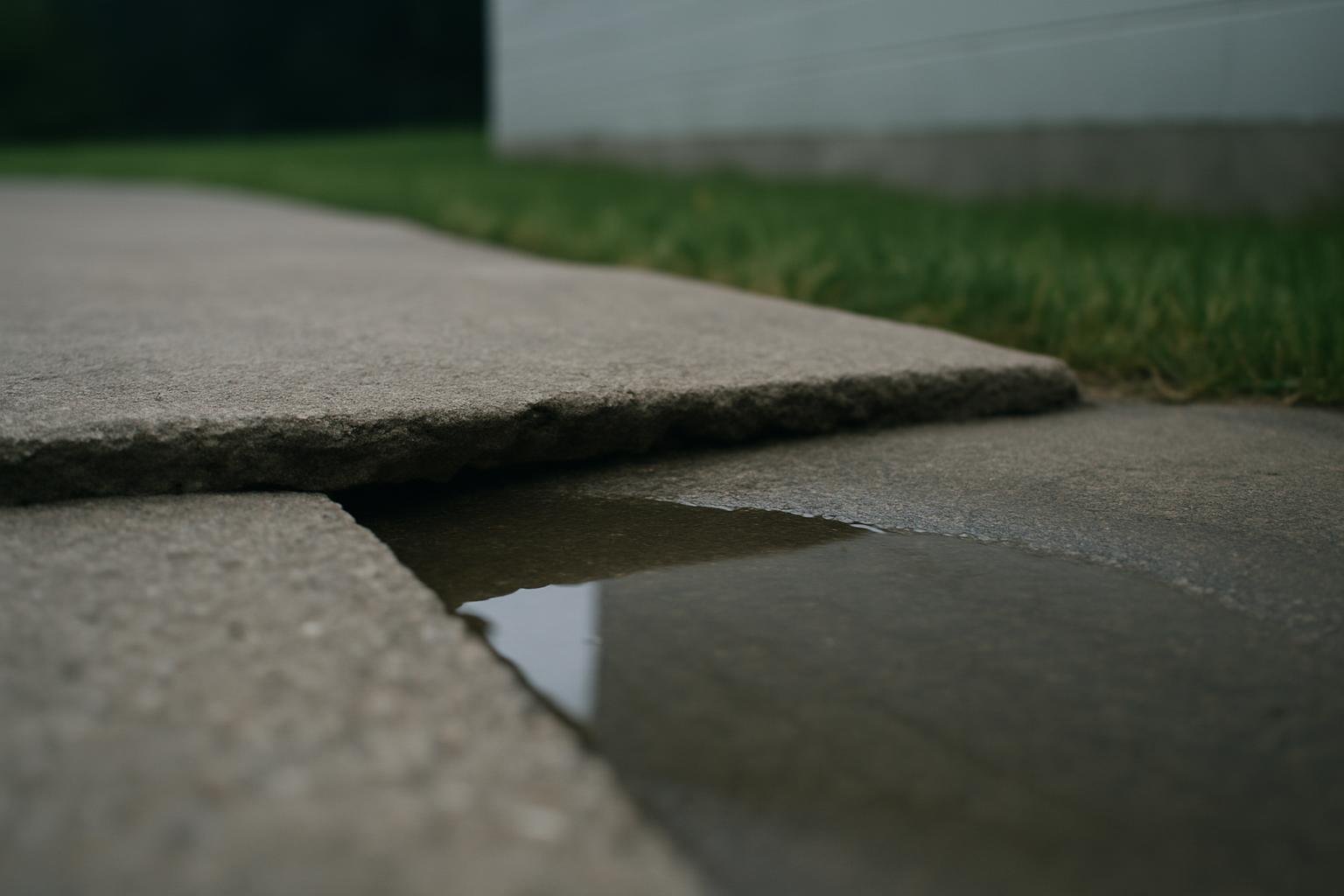
Lift or replace a slab that has sunk, tipped or heaved, and deal with the drainage underneath it so the same thing does not happen next spring.
Concrete Leveling quote
Tell us which slab has moved, which way it went, and whether a downspout, ditch or culvert sits near it. That is what decides between lifting and replacing, and we will put you in front of insured contractors who look at the water first.
Would you rather talk it through? Call (315) 640-3590, answered 24/7.
$100 off your first job
Credited by us on your first booked job.
- One credit per customer per property, on your first booked job.
- Valid through December 31, 2026.
Mention this offer when you book. Full terms.
Why the slab moved, and what that changes
A slab that has sunk, tipped or lifted has not necessarily failed. The ground under it has moved, and that is a completely different job from a surface repair. The mechanism matters because it decides what the fix has to include. New York State's Department of Transportation is explicit that three conditions must all exist before frost heaving can occur: freezing temperatures penetrating below the surface into the base and subgrade, a supply of water into the freezing zone, and frost-susceptible material lying within that zone. Eliminate any one of them completely and there is no noticeable heave. Since the climate here is not negotiable, the department names drainage, in the form of ditches, culverts and underdrains, as the condition that can actually be reduced. Which is the whole point: leveling work that does not touch the water is leveling work you will be buying again.
- Lifting and re-leveling sunken slabs, walks, aprons and garage floors
- Replacing a slab that broke up as it moved, where lifting the pieces would only rejoin the cracks
- Grinding or cutting out a trip lip where two slabs no longer meet flush
- Filling voids under slabs that have lost support after a thaw
- Fixing the drainage that fed the movement: grading, downspout discharge, ditches and culverts
- Re-bedding and compacting the fill under a slab that is coming out anyway
- Re-establishing joints so the repaired run can move without cracking somewhere new
What decides whether a slab can be lifted
Settlement work is priced on the ground and on the water, not on the concrete sitting over them. The ground gets answered first, every time.
Whether the slab is still one piece
A slab that dropped as a unit can often be lifted. One that broke into three pieces on the way down cannot be put back level without the cracks traveling with it, and that is a replacement. NRMCA's position is that cracking cannot be prevented entirely, only controlled, so the useful question is not whether there are cracks but whether the panel will move as one thing.
Where the water is coming from
New York State's Department of Transportation states that it is not normal soil water which causes noticeable frost heaves, because water expands only 9 percent in volume when freezing and makes up only a low percentage of the soil mass, and a 9 percent increase in that small volume cannot account for the large ice lenses that form in the freezing zone. Water must be supplied, usually from below and the sides, for those lenses to grow, and much of that supply can be cut off by adequate drainage. That is why the downspout, the grade and the ditch get looked at before the slab does.
What the ground under your address is rated
New York State's Department of Transportation states that practically all the state's surface soils undergo some frost action, ranging from moderately susceptible glacial tills and dirty sands and gravels to highly susceptible fine sands, silts and rock flour. Weighting the USDA soil survey of Onondaga County by acreage, 26.9 percent of mapped component acreage is rated High for potential frost action and 53.4 percent Moderate, with 0.7 percent Low and 19.1 percent carrying no rating at all because it is water, urban land or unsurveyed ground. The largest High-rated series here are mostly silt loams.
Whether the movement is uniform or differential
NYSDOT's position is that heaving, if uniform, is not generally destructive and may be invisible to anyone unless levels are taken in summer and winter, and that it is only destructive and troublesome when it is differential or sharply varying. It lists where that shows up: over culvert pipes, adjacent to driveways damming highway ditches because the driveway culvert is blocked or non-existent, where ditches are inadequate or non-existent, and wherever there is an abrupt and drastic change in subgrade material, subbase thickness or drainage. If your slab matches one of those, the cause already has a name.
The season you are looking at it in
NYSDOT describes the thawing half of frost action as loss of support: the thawing zone sits above ground that is still frozen, the meltwater cannot drain, the soil becomes saturated and loses most of its bearing capacity, and it can no longer carry a wheel load. The department calls the result spring break-up. A slab that only rocks in March is telling you about drainage, and a slab measured in August can read level when it is not.
What is under the slab now
NRMCA lists improper subgrade preparation among the causes of the majority of concrete cracks, and its practice is that topsoil and soft spots come out, the fill beneath is compacted by rolling, vibrating or tamping, and the slab is sloped to drain. NYSDOT's specification for non-frost-susceptible material is a clean sound sand and gravel with 30 to 65 percent passing the 1/4 inch sieve and absolutely not more than 10 percent passing the No. 200 sieve, which is a useful thing to be able to ask for by name.
Not sure whether it settled or just cracked?
One is put right from underneath and one from the top. They cost very different amounts.
How settlement work is sequenced
Take levels rather than opinions
Where the low point is, how far it has dropped, and whether the movement is uniform across the slab or differential across a line. NYSDOT's point that uniform heave may be invisible to anyone unless levels are taken in summer and winter cuts both ways: without measurements, nobody is describing this accurately, including the person quoting.
Find the water before touching the concrete
Three conditions have to be true at once for frost heaving, and drainage is the one NYSDOT identifies as reducible. So the survey is downspouts, surface grade, the ditch line, and whether a driveway culvert is blocked or missing. This is the step that decides whether the repair holds, and it is the step most often skipped because it is not concrete work.
Decide lift or replace on whether the slab travels as one piece
An intact panel that has dropped can usually be raised and supported. A slab already broken into pieces, or one that is scaling badly on top as well as sitting low, is a replacement, because lifting it puts the same cracked surface back at a better height.
Fix the drainage first
Grade away from the building, get the downspout discharge away from the slab edge, clear or replace the culvert, reopen the ditch. On a county road the ditch cannot simply be piped and paved over: the county's stated long-standing policy is not to allow ditch enclosures because of the numerous problems they create.
Lift and support, or break out and rebuild the base
NYSDOT notes that frost penetration reaches as deep as 5 feet in some areas of the state, which is exactly why replacing frost-susceptible soil to the full depth of frost is expensive. That is the practical argument for cutting off the water rather than excavating the problem, and where the slab is coming out anyway, for putting back clean compacted granular fill sloped to drain.
Reset the joints so the run can move
Joint spacing at 24 to 36 times the slab thickness, capped at fifteen feet, panels square or nearly square with no L-shapes, and isolation joints wherever the slab meets a wall, a footing, a garage slab, steps or a light pole. NRMCA's framing is that joints are pre-planned cracks, so the choice is where the crack goes, not whether there is one.
Pour any replacement inside a window it can be protected through
ACI 306R-16 treats cold weather as beginning when air temperature has fallen to or is expected to fall below 40F during the protection period, which is 2, 3 or 6 days by load and exposure. Syracuse averages 13.9 nights at or below 40F in October and 24.2 in November, so a late-season replacement is a protected pour or a spring job.
Look at it again after a freeze and a thaw
NYSDOT's own standard for detecting heave is levels taken in summer and winter. A slab that reads right in September and rocks in March has told you something a single visit cannot, and it is worth putting a mark on the wall and checking rather than assuming.
Where this service starts and stops
When you may not need this at all
- If the whole slab has risen evenly, there may be nothing to fix. NYSDOT states that heaving, if uniform, is not generally destructive and may be invisible to anyone unless levels are taken in summer and winter. It is differential movement that does the damage.
- If the slab is level and the surface is peeling, this is not the service you need. That is a surface durability failure, repaired, resurfaced or replaced from the top, and it is priced completely differently.
- If the movement follows a downspout, a blocked driveway culvert or a ditch that has silted in, the drainage work may be most of the answer on its own. NYSDOT names drainage as the one of the three frost heave conditions that can actually be reduced, so it is worth doing that first and watching before committing to concrete.
- If you are looking at it in August, look again in March before you commit. NYSDOT's spring break-up is the season in which loss of support actually shows, and a slab that reads level in summer can move under load in a thaw.
- If the trip hazard is on a public sidewalk inside the City of Syracuse, that is the city's to put right. It has repaired and replaced sidewalks itself since the second half of 2021, hazardous conditions are reported to CityLine, and you are already paying for it through the yearly sidewalk fee.
What is out of scope
- House foundations, footings, piers and structural underpinning of a building, which are an engineered specialty.
- Basement wall repair, waterproofing and interior drain tile.
- Asphalt, pavers and gravel surfaces.
- Public sidewalk work inside the City of Syracuse, which the city carries out itself.
- Piping or enclosing a roadside ditch on a county highway, which the county's long-standing policy does not permit.
- Sinkhole and subsidence investigation and any geotechnical report, which needs an engineer rather than a contractor.
- Tree removal and root cutting, even where the roots are part of why the slab moved.
Where we arrange leveling and settlement work
What people ask about a slab that has moved
I was told water in the ground expands when it freezes and lifts the slab. Is that right?
Not really, and the difference changes what the fix has to be. New York State's Department of Transportation's own manual states that it is not normal soil water which causes noticeable frost heaves, because water expands only 9 percent in volume when freezing and comprises only a low percentage of the soil mass, and a 9 percent increase in that small volume cannot account for the increase caused by the formation of large lenses of ice in the freezing zone. Water has to be supplied, usually from below and the sides, for those ice lenses to grow, and the supply of much of that water can be cut off from the freezing zone by adequate drainage. So the lever is not a thicker slab or more reinforcement. It is the downspout, the grade, the ditch and the culvert. Any leveling proposal that says nothing about the water has not answered the question you are actually asking.
Can my sunken driveway or walk be lifted rather than replaced?
It comes down to two things. First, whether the slab will travel as one piece: an intact panel that has dropped can usually be raised and supported, while one that has already broken into sections will simply arrive at the new height with the same cracks in it. Second, whether the cause has been dealt with. NYSDOT's three conditions for frost heaving are freezing penetrating into the base and subgrade, a supply of water into the freezing zone, and frost-susceptible material in that zone, and it says that eliminating any one completely means no noticeable heave. The climate is fixed, and the department itself points out that replacing frost-susceptible soil to the full depth of frost is expensive because penetration reaches 5 feet in some areas of the state. That leaves the water, which is why a lift without a drainage fix tends to be a temporary result at full price.
Is the ground around Syracuse especially bad for this?
Most of the county is moderate or worse, and the honest differentiator between two addresses is drainage rather than geography. The US Department of Agriculture defines potential for frost action as the likelihood of upward or lateral expansion of soil caused by segregated ice lenses forming, and the collapse and loss of strength that follows on thawing, and it rates silty and highly structured clayey soils with a high water table in winter as most susceptible, with well drained, very gravelly or very sandy soils least susceptible. Weighting the USDA survey of Onondaga County by acreage, 26.9 percent of mapped component acreage is rated High for potential frost action and 53.4 percent Moderate, with 0.7 percent Low and 19.1 percent unrated because it is water, urban land or unsurveyed. The largest High-rated series here are mostly silt loams. New York State's Department of Transportation puts it more bluntly still: it is obvious that practically all of New York State has frost-susceptible soils.
How deep does the base have to go to get under the frost line?
Nobody can give you a number for this county from a code book, and it is worth knowing why. In the Residential Code of New York State, Table R301.2(1), the climatic and geographic design criteria, is published with every column blank and the values are established by the local jurisdiction, with footnotes directing that jurisdiction to fill in both the weathering index for concrete and the minimum depth of footing below finish grade. New York's regulation 19 NYCRR 1202.12 then makes the owner responsible for supplying those criteria as established by the city, town or village with a permit application, and where local criteria have not been established, for obtaining them from a registered architect or professional engineer. So the depths that circulate for New York have no statewide basis, and the answer for your address comes from your municipality. For flatwork specifically, NYSDOT's own conclusion is that drainage, not excavation depth, is the condition worth attacking.
Will it move again after it is fixed?
Nobody honest will tell you the ground is now permanently still, and it is fair to be suspicious of anyone who does. What can be said is what has to be true for it to happen again. NYSDOT's three conditions all have to be present at once: freezing penetrating below the surface into base and subgrade, a supply of water into the freezing zone, and frost-susceptible material lying in that zone. Remove any one of them completely and there is no noticeable heave. The climate stays, and taking out the susceptible soil to the full depth of frost is the expensive route the department itself flags. So the water is the condition that gets attacked, which is why the proposals worth reading talk about the downspout, the surface grade, the ditch and the culvert before they talk about the concrete.
Tell us which way the slab has moved
Down, up, or one corner only. Each one points at a different cause.