
Syracuse and the surrounding New York area
Concrete Steps, Walkway and Patio Repair in the Syracuse Area
Rebuild crumbling front steps, deal with a stoop that has dropped away from the house, and repair the walkway or patio you have stopped inviting people onto.
Steps and Walkways quote
Tell us which surface it is and what it is doing, whether that is peeling, cracking, sinking or crumbling at the edge. That is what decides between a rebuild and a repair, and we will put you in front of insured contractors who say which one it is before they price it.
Would you rather talk it through? Call (315) 640-3590, answered 24/7.
$100 off your first job
Credited by us on your first booked job.
- One credit per customer per property, on your first booked job.
- Valid through December 31, 2026.
Mention this offer when you book. Full terms.
Steps, the stoop, the front walk and the patio
Steps get rebuilt or replaced, a stoop that has dropped gets dealt with from underneath, and a walkway or patio has sections cut out or the whole run taken up and repoured. What these surfaces have in common is that they are the ones people salt by hand, so they take de-icer applied directly at full strength rather than tracked in off a road. The Residential Code of New York State treats them as their own category for that reason: exterior porches, carport slabs and steps sit alongside garage floor slabs in Table R402.2, and section R402.2 caps the fly ash, slag and silica fume permitted in mixes for exactly those elements where they will be exposed to de-icing chemicals. Getting the specification right on a set of steps is a small part of the bill and most of the service life.
- Rebuilding or replacing poured concrete steps, treads and risers
- Stoops and landings that have dropped away from the house, where the work is under the slab rather than on top of it
- Front walks and side paths on your own property, sections cut out or the whole run repoured
- Poured concrete patios, including the joint layout that stops a wide slab cracking where it likes
- Resurfacing lightly to moderately scaled treads and flatwork where the base surface is still sound
- Replacing the isolation joints where a walk meets the steps, the driveway or the garage slab so each can move independently
- A breathable silane or siloxane repellent on flatwork that is still sound, applied when the concrete is reasonably dry
What changes the scope on steps and flatwork
Foot-traffic concrete is priced on how it was built and on what has moved underneath it. Six questions between them decide the scope.
Whether the steps have deteriorated or moved
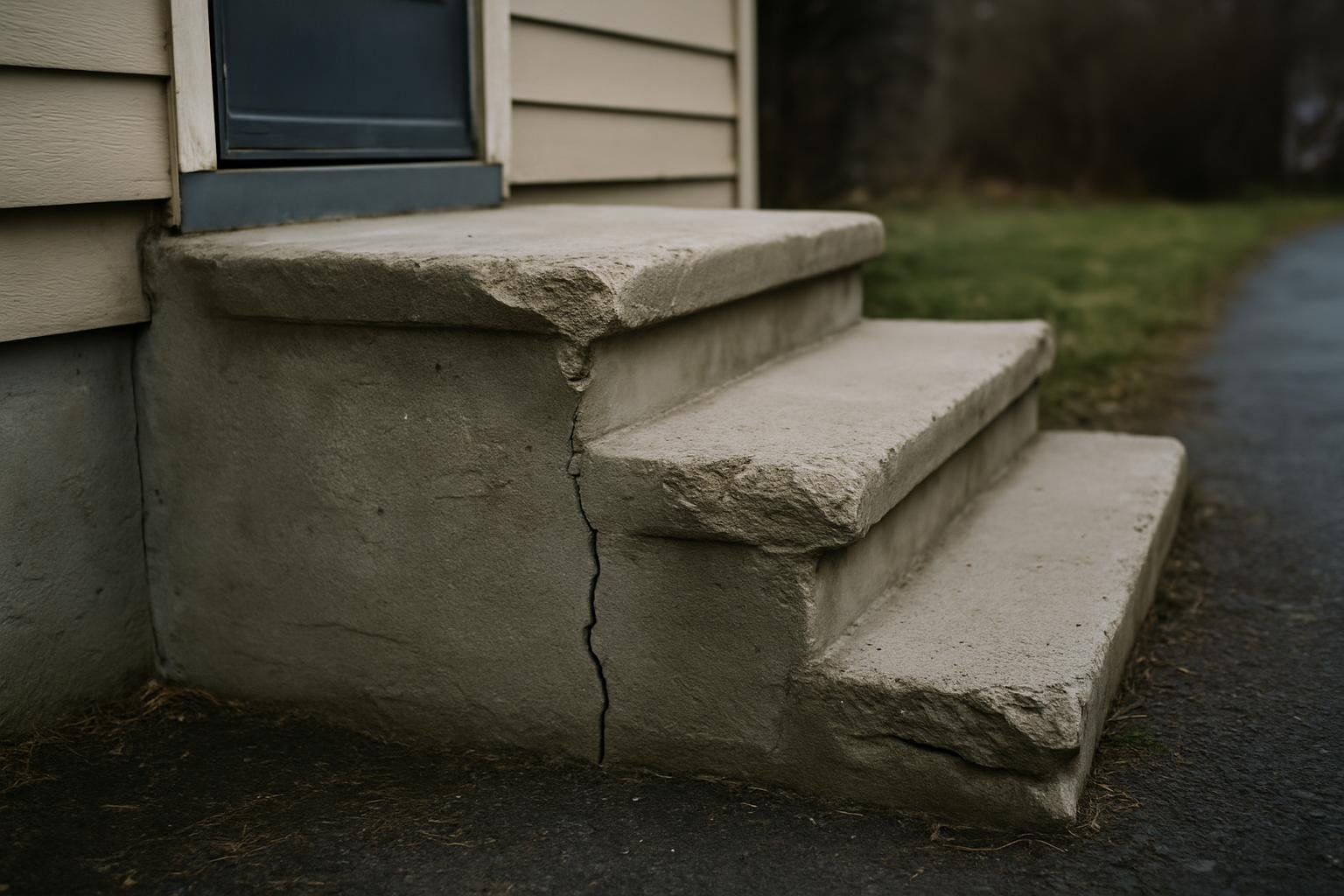
A tread crumbling at the nose is a surface failure and can often be rebuilt off the existing structure. A whole flight that has tilted or pulled away from the house has moved, and a new top on it repeats the problem within a couple of winters. New York State's Department of Transportation's account of heave is that it is only destructive when it is differential or sharply varying, and it names abrupt and drastic changes in subgrade material, subbase thickness and drainage conditions among the places that happens. A stoop against a heated foundation wall is exactly such a change.
How the de-icer gets applied here
Steps and walks are the one place a homeowner salts deliberately, so they take chemical at full strength. New York State's Department of Environmental Conservation puts the amount actually needed at twelve ounces of rock salt for a twenty foot driveway, notes that rock salt will not melt snow or ice below 15F, and says the first step is to shovel what you can, because removing the snow first reduces how much salt is needed. A great deal of the damage on a set of steps is over-application rather than winter.
What the code asks for, and what the mix actually was
Table R402.2 of the Residential Code of New York State sets the minimum specified compressive strength for porches, carport slabs and steps exposed to the weather at 2,500 psi where weathering is negligible, 3,000 where it is moderate and 3,500 where it is severe, and its footnote requires air entrainment of not less than 5 and not more than 7 percent by volume. On work poured decades ago nobody can tell you what was delivered, which is why the way the surface is failing is the evidence you have.
Which surfaces are yours to pay for
Inside the City of Syracuse the public sidewalk is not one of them. The city took responsibility for the repair and replacement of existing sidewalks in the second half of 2021 under its Municipal Sidewalk Maintenance Program, funded by a yearly fee on every property in the city, and it runs a fee exemption for owners who completed permitted sidewalk work within ten years of the permit date. The walk from that sidewalk up to your own door is yours. The sidewalk itself is not, and that changes the scope of the job.
How the joints are laid out
NRMCA's recommended practice is a maximum joint spacing of 24 to 36 times the slab thickness, about ten feet for a four inch slab and capped at fifteen feet in any case, with panels square or nearly square, length no more than one and a half times the width, and L-shaped panels avoided. A patio wrapping a house corner is an L-shaped panel unless somebody plans it not to be. NRMCA calls joints pre-planned cracks and says cracking cannot be prevented, only controlled.
How the surface was finished
NRMCA records that concrete sometimes peels or scales with no freezing and thawing involved at all, often from the early use of a steel trowel, over-finishing, or finishing while bleed water is still on the surface, and that excessive finishing reduces the entrained air in the surface layer. For most exterior surfaces it says a broom finish is adequate. A patio troweled smooth for looks is the slab most likely to be peeling five years later.
Not sure the steps need replacing at all?
How deep the damage runs decides that, and it takes a few minutes to look at properly.
How steps and flatwork are put right
Separate a surface failure from something that has moved
Crumbling noses, flaking treads and a pitted walk are surface problems. A flight pulling away from the house, a stoop sitting low, or two slabs that no longer meet flush are movement. They are different trades of work at different prices, and a homeowner genuinely cannot tell them apart from a photograph.
Confirm what is actually yours
Inside the City of Syracuse the city has repaired and replaced existing sidewalks itself since the second half of 2021, funded by a fee on every property, so a public sidewalk is not work to buy. Outside the city it varies by municipality. The private walk, the steps, the stoop and the patio are yours wherever you are.
Test whether the base surface will take a repair
NRMCA's conditions for a repair are specific: the unsound surface has to be removed first by hammer and chisel, sandblasting, high-pressure washing or jack hammer, the surface receiving the repair must be sound, and the repaired surface will only be as strong as the base it has to bond to. It also says the repair material will not match the color and characteristics of the original concrete.
Prepare the ground under it
Topsoil and soft spots removed, granular fill compacted by rolling, vibrating or tamping, and the finished surface sloped to drain away from the house. NRMCA lists improper subgrade preparation among the causes of the majority of concrete cracks, and it is the step nobody can inspect once the concrete is down.
Form the work and set the isolation joints
NRMCA's practice is that isolation joints separate slabs from walls, footings and columns, and separate driveways and patios from sidewalks, garage slabs, stairs, light poles and other points of restraint, so each element can move independently. A walk poured hard against a stoop and a foundation has nowhere to go, and the crack appears at the stiffest point.
Order air-entrained concrete and keep water out of it on site
NRMCA's specification for a slab that will be continuously moist, exposed to freezing and subject to de-icing chemicals is 4,000 psi, consistent with ACI 332, the code for residential concrete, with 6 percent total air at 3/4 or 1 inch coarse aggregate, a 3 to 5 inch slump, and no excessive water added at the jobsite. Water added at the truck to make finishing easier is paid for later at the surface.
Broom it rather than polish it
A broom finish is what NRMCA calls adequate for most exterior surfaces, and it is also the finish that keeps entrained air in the top layer where the freezing and thawing happens. On treads it has the second benefit of being the one people do not slip on in February.
Protect it, cure it, and give it a winter on sand
ACI 306R-16 puts the protection period for normal-set concrete at 2 days unloaded and not exposed, 3 days unloaded and exposed, and 6 days partially loaded and exposed. Curing is separate and NRMCA puts it at typically 3 to 7 days. Then no de-icing chemicals at all in the first winter, with clean sand for traction, which is NRMCA's own rule and the cheapest thing anyone can do for new steps.
Where this service starts and stops
When you may not need this at all
- Fine random cracking across a patio or a walk, in irregular patches no more than about an inch and a half across, is crazing. NRMCA states it does not affect the structural integrity of concrete and is generally not a precursor to future deterioration, durability or wear resistance. It usually needs nothing.
- Light scaling that has not exposed the stone is, in NRMCA's own words, a cosmetic issue that may not need repairing at all.
- A public sidewalk in the City of Syracuse is not yours to replace. The city has done that work itself since the second half of 2021 and charges a yearly fee on every property to fund it, so paying a contractor for it is paying twice. Hazardous conditions get reported to CityLine.
- If a hollow sound comes back when the surface is tapped with a hammer, that is delamination, a thin layer 1/8 to 1/4 inch thick separating from the concrete beneath. NRMCA puts the cause at the surface being densified by troweling while the concrete underneath was still plastic and bleeding. It is a finishing fault, so on newer work the party who poured it is the first conversation.
- If the steps are sound and the only complaint is that an old patch is a different shade, nothing will fix that. NRMCA states plainly that repair material will not match the color and characteristics of the original concrete.
What is out of scope
- Public sidewalk replacement inside the City of Syracuse, which the city carries out itself.
- Pavers, flagstone, brick and segmental block, which are set on a bed rather than poured.
- Timber and composite decks, deck footings and porch framing.
- Iron and aluminum railings as standalone work, beyond dealing with posts set into concrete that is being replaced.
- Retaining walls and structural masonry.
- Pressure washing, staining and sealing as standalone cosmetic work.
- Snow and ice clearing, which inside the city stays the property owner's duty and has to be done by 6 p.m. on the day after accumulation.
Where we arrange steps and flatwork
- Steps and Walkways in Syracuse
- Steps and Walkways in East Syracuse
- Steps and Walkways in Solvay
- Steps and Walkways in Liverpool
- Steps and Walkways in North Syracuse
- Steps and Walkways in Salina
- Steps and Walkways in DeWitt
- Steps and Walkways in Manlius
- Steps and Walkways in Fayetteville
- Steps and Walkways in Skaneateles
What people ask about steps, walks and patios
My front steps are crumbling at the edges. Do they have to be replaced?
Not necessarily, and the deciding factor is depth rather than looks. NRMCA grades surface loss: light scaling does not expose the coarse aggregate, moderate scaling exposes it and involves a loss of up to 1/8 to 3/8 inch of the surface mortar, and in severe scaling more surface has gone and the aggregate clearly stands out. Light to moderately scaled surfaces can be repaired, provided the unsound material is removed first and what is left underneath is sound, because a repair is only as strong as the base surface it has to bond to. Where NRMCA draws the line is excessive and progressing scaling, which it says may not be feasible to repair at all. Add one more question on steps specifically: if the flight has tilted or separated from the house, the structure has moved and resurfacing it is money spent twice.
Who pays to fix the sidewalk in front of my house?
Inside the City of Syracuse, the city does. Under its Municipal Sidewalk Maintenance Program the city took responsibility in the second half of 2021 for the repair and replacement of existing sidewalks and for expanding the network, working with the Syracuse Metropolitan Transportation Council on priorities. Before that, owners were responsible for maintenance and replacement, sidewalks were condemned if found unsafe, and enforcement was mostly complaint-driven. The program is funded by a yearly fee on every property in the city including tax-exempt ones, phased in at $20 residential and $60 commercial and rising each year to a set $100 and $300, with the whole program estimated at $4.5 million a year and the money collected in each of four districts spent in that district. Owners still clear snow and ice, by 6 p.m. on the day after it accumulates, and there is a fee exemption for owners who completed permitted sidewalk work within ten years of the permit date. Outside the city it varies by municipality, so ask before buying. What is always yours is the walk between that sidewalk and your own door.
Can I salt my new steps this winter?
No, and this is the cheapest thing on the whole page. NRMCA's stated rule is to avoid de-icing chemicals in the first winter and use them in moderate amounts afterwards, with clean sand for traction in the meantime, because newly installed concrete tends to be saturated and of lower strength and it lists excessive de-icer on new concrete among the causes of most scaling. On which product, NRMCA names calcium chloride and sodium chloride, which is rock salt, as acceptable for concrete, and says ammonium sulfate, ammonium nitrate and magnesium-based salts should never be used as a de-icer because they are chemically aggressive and destroy concrete surfaces. Read the bag rather than the front of it.
Why does my patio look worse than the driveway, when the driveway takes all the traffic?
Usually the finish rather than the use. NRMCA records that concrete occasionally peels or scales in the absence of freezing and thawing altogether, and that this is often due to the early use of a steel trowel, over-finishing, or finishing while bleed water is still on the surface. It also warns that placing and finishing procedures can reduce the entrained air content, and that excessive finishing reduces entrained air in the surface layer specifically. Since entrained air is what gives freezing water somewhere to expand into, a smooth surface with the air troweled out of it is the least durable concrete on the property. NRMCA's own recommendation is that a broom finish is adequate for most exterior surfaces, and a patio is the slab most likely to have been polished for looks instead.
When is the right time to seal a walkway or patio?
NRMCA recommends a commercially available silane or siloxane based breathable concrete sealer or water repellent specifically designed for use on concrete slabs, applied following the manufacturer's instructions, and it states the concrete should be reasonably dry before a sealer goes on. It names late summer with a few dry days preceding application as the ideal time. So not the week of the pour, and not onto a damp slab in November when the first cold night is already in the forecast. On a slab that is still sound, a sealer plus rinsing the salt off when the weather allows is a genuinely cheap way to buy years.
Tell us which surface, and what it is doing
Steps, stoop, front walk or patio. Each one fails in its own way.