Fayetteville slab leveling
Sunken slab in Fayetteville: is the panel too big, or is the base gone?
One slab at your Fayetteville house has dropped, and the lip is catching feet and wheelbarrows. Tell us where and how far, and we introduce a local contractor to say whether lifting it will hold.
Leveling job ahead? Book it, and our credit of $100 off your first job applies.
From the house to the street
- Garage floorYours
- Steps and walksYours
- DrivewayYours
- ApronYours, with a permit
- Public sidewalkAsk the village
- StreetRoad owner
This fits when
When slab leveling work in Fayetteville is next
The sunken panel is longer than it is wide
Long panels crack and drop at the middle. Measure its length and width and send both numbers.
The slab dropped where it meets the street
The apron may be a road owner's to approve. Check whose street it is before you book.
The patio slab tilts toward the house
Water running to the wall is the bigger problem. Photograph the downspout.
The slab is only one of three that sank
If several panels fell together, the base may have moved. Send photos of all of them.
Questions
Slab leveling questions from Fayetteville homeowners
- 1
Can an oversize panel be fixed in Fayetteville?
Sometimes. A panel much longer than 15 feet may do better cut into smaller panels. Ask the contractor whether a lift or a cut and replace suits yours.
- 2
What do I send about a sunken slab?
Send the length, width and drop, photos of the low corner and the nearest downspout, and any digging nearby.
- 3
Does the village decide about a sunken apron?
On a village street, it is the village's call. On the county or state stretches, those owners decide.
- 4
Will a lift last?
It depends on the base and the panel size. Ask the contractor to say what holds the slab up after the lift.
Ask about your slab
Send us your Fayetteville address
Send the details once. Nothing is booked and you owe nothing for asking.
We help you work out whose concrete it is and what to ask for, then introduce you to an independent Syracuse-area contractor to quote it.
Put it in writing before anyone pours
Seven questions for any contractor, any slab. Copy them into your messages and keep the answers with your contract.
- Air-entrained mix, with the air content namedThe mix decides whether the surface flakes again in a few winters.
- The pour date, and a plan if it turns coldCold nights after the pour count, even when the pour day is mild.
- How the slab is cured and coveredCuring and cold protection run for different lengths of time.
- No de-icer on the new slab this winterClean sand gives traction without feeding the scaling.
- Whose road it is, and who pulls the permitWork in a county road right of way needs a county permit first.
- A signed written contract before work startsNew York asks for a written contract on home improvement jobs over $500.
- What is removed, what is poured, what is leftA clear scope stops arguments about patching versus replacing.
$100 off your first job
Your $100 comes off once your first concrete job is booked.
- The credit comes from us, not out of the contractor's price.
- One credit per customer, per property.
- Your job needs to be booked by December 31, 2026.
- Mention the $100 when you book the work.
The straight-answer slab promise
- No charge to ask, and no obligation once you have.
- If the city or the road owner should fix it, we say so.
- We ask about the mix and the pour month up front.
- Your $100 is applied the way our Terms spell out.
Your contract is with the contractor, who answers to you for the work.
Concrete Repair Syracuse, (315) 640-3590
Panels that are too big sink first
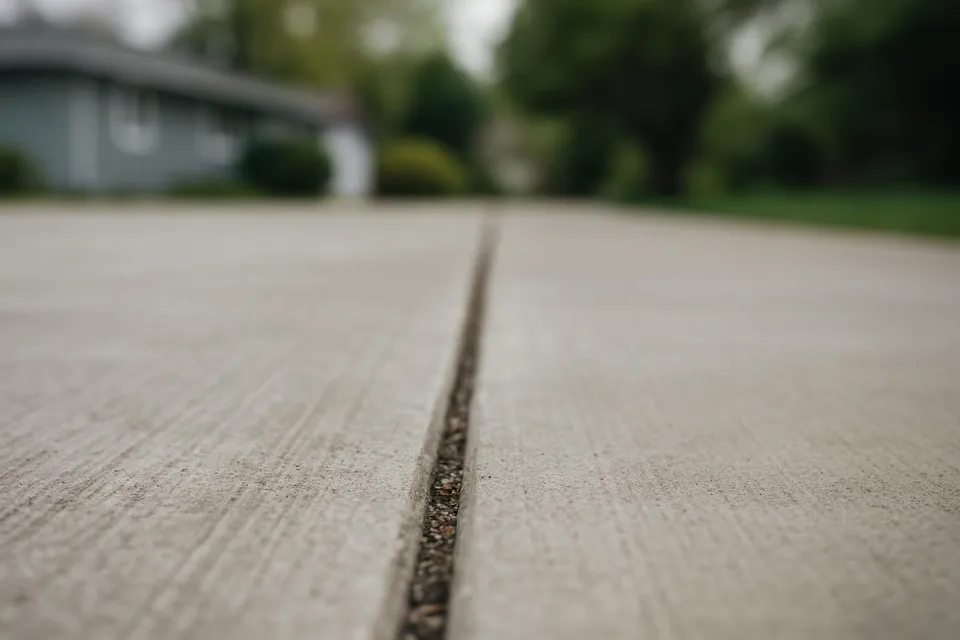
NRMCA's guide for joints is a spacing of 24 to 36 times slab thickness, which works out near 10 feet for a 4 inch slab, with 15 feet as the limit and square panels preferred. A panel far longer than that has stress building at its middle, and it often cracks and drops there.
Send us the slab details.
Sketch the slab and mark any joint you can see, even a faint one. A panel with no joint at all has nowhere to go when the ground moves under it, so a panel like that can drop while its neighbors stand.
Measure your sunken slab. If it is longer than 15 feet, ask the contractor whether a lift will hold, or whether cutting it into smaller panels is the better first move.
Basis: NRMCA U.S. Census Bureau
Start with the street and the slab.
Housing from 1961 and what is under it
The village's middle house dates from 1961, and more than three in four homes predate 1980. Fill under older slabs has had decades to settle and wash out. Ask the contractor what is beneath yours and where the water goes after a thaw.
Tell the contractor about any digging nearby, such as a new line or a drain. Those are the things that move soil.
Check the downspouts, too. One that empties beside the slab can wash out the base over time, and the fix may be a longer pipe, not a lift.
Basis: New York State DOT
When the slab sits at the village street
Of Fayetteville's 23.5 road miles, 19.5 are village street, 1.5 are county road and 2.6 are state road. If your sunken slab is the apron, the owner of that road may have to approve the work. Ask the village code office which owner handles your frontage, and write the name of that owner on the quote.
On your own lot, you decide. Get the lift method on paper, with the days you stay off the slab and the contractor's plan if it drops again.
Ask for a replacement price for the same slab. When you hold two prices for the same panel, the choice between lifting and replacing gets simple.
Book the introduction, then compare the paperwork.
Same address
Four more slabs a Fayetteville property may have
Close by
The same job next door
Get it in writing before anyone pours.